Showing posts with label dead media/obsolete technology. Show all posts

Tuesday, March 1, 2011

INSECT MEDIA: An Archaeology of Animals and Technology

By Jussi Parikka, University of Minnesota Press | 320 pages | 2010
Posthumanities Series, volume 11
Book launch /March 4th, 19.00, General Public, Schönhauser Allee 167c, Berlin

Insect Media analyzes how insect forms of social organization - swarms, hives, webs, and distributed intelligence - have been used to structure modern media technologies and the network society. Through close engagement with the pioneering work of insect ethologists, posthumanist philosophers, media theorists, and contemporary filmmakers and artists, Jussi Parikka provides a radical new perspective on the interconnection of biology and technology.

More info at http://www.jussiparikka.com and his blog Cartographies of Media Archaeology.

Friday, December 3, 2010

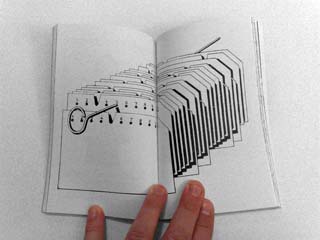
A Collection of Many Problems (In Memory of the Dead Media Handbook)


telharmonium

http://www.conceptlab.com/problems/ && http://www.conceptlab.com/problems/milan/ for the documentation
book available for 7.78$ at: http://www.lulu.com/product/paperback/a-collection-of-many-problems-%28in-memory-of-the-dead-media-handbook%29/5486558


from http://net-art.org/node/240:

problems.jpg

"A Collection of Many Problems" by Garnet Hertz, extracted out of the Ancient and Modern Philosophers: as, Secrets and Experiments in Informaticks, Geometry, Cosmography, Horologiography, Astronomy, Navigation, Musick, Opticks, Architecture, Statick, Mechanics, Chymistry, Water-Works, Fire-Works, &c. In memory of the Dead Media Handbook.

This book concept is a continuation of Bruce Sterling's Dead Media Handbook proposal (1995), and is influenced by contemporary writings in media archaeology. Its format is inspired by Quentin Fiore's design of Marshall McLuhan's The Medium is the Massage: An Inventory of Effects (1967).

Licensing: This bookwork is currently being sold at cost and without profit to the author, and is distributed under a Creative Commons Attribution 2.5 License: you are free to share, copy, distribute, transmit, remix and adapt the work.

Wednesday, November 17, 2010

taxonomedia project

A Taxonomedia (Consuelo Rozo and Vanina Hofman) interview by Raquel Herrera posted at the new media fix website can be found here.

We, in Taxonomedia, regard documentation as a privileged tool to explain an important artistic production which hardly could be conserved through other kinds of strategies. On the one hand, because of the essentially economic questions we have previously mentioned. The conservation projects that suggest solutions such as emulators and migrations are beyond the scope of most museums and media spaces, and probably their efforts in that direction are not sustainable in the medium or long run. On the other hand, there are expressions within art based on technologies that don’t “allow for their conservation”, and if presented with this situation, the artist’s intention must be respected. Finally, also, through their documentation and subsequent availability, the work might be able to survive as a concept and be recreated in other works. Projects like Variable Media delve into the conservation of the integrity of the work regardless of its medium, clearly considering media art within the field of conceptual art, emphasizing a perspective which many would find inadmissible, but is interesting to us.
(...)

To be able to access this material as it was in this day represents a huge time investment, a specific budget, provided also that the artist wants to work on that again. In some cases this might mean counting on programmers and developers to generate platforms that allow the piece to work seamlessly in current environments. We have translated a paradigmatic case undertaken for the exhibition Seeing Double (Guggenheim Museum) about the work The Erl King by Roberta Friedman and Grahame Weinbren. Examples like these are feasible if there’s an institution like a museum, a specialized archive or a project that might take charge. It is also possible, if the artist was willing to undertake it herself, as could be in the example you mentioned. She might add some ideas to the piece she didn’t include in the past and the technology she might have to use might also alter the particularities of the work. So we can imagine The Intruder might be different if manipulated, although we leave this aspect at the hands of the artist.

Reinterpretation and documentation are ways of contact with many of the previous works, but unfortunately the experience is hardly repeatable.


Wednesday, January 7, 2009

The Polaroid Picture, 1972-2008 - Ross Rosenberg (2009.01.06)


"December 2008 marked the passing of an era in photography as Polaroid Corporation ceased manufacturing instant film, meaning that soon the only way you’ll be able to admire their otherworldly ability to rob reality of spacial relationships will be at garage sales and on Flickr. lens culture posted this fantastic infomercial for the SX-70, the quintessential instant camera. Watching this ad, with its detailed animation of the internal voodoo taking place inside the camera’s body and the chemical process of the self-developing film I’m struck by the ingenuity of “vintage” technology. There’s something about these kinds of devices that I find infinitely more interesting than current gadgets.

I think it has mostly to do with the fact that this kind of gadget is much more about miniaturization than anything. While current technology has a preoccupation — one could say obsession — with combining as many disparate facets of modern existence into a single carapace, something like the SX-70 was meant solely to shrink an otherwise bulky endeavor; in this case the entirety of a photo-lab physically crammed into an object that could fit inside a coat pocket. As astounding as the abilities of a Blackberry may be, it pales in comparison to the idea of, say, a tiny, collapsible printing press."

Polaroid SX-70 Ad [YouTube] : lens culture" - Ross Rosenberg (2009.01.06)
http://www.ectomo.com/index.php/2009/01/06/the-poloroid-picture-1972-2008/

Thursday, December 18, 2008

atompunk + the dead media project

a recent mailinglist started by bruce sterling about the cultural period 1945-1965
http://www.antenna.nl/mailman/listinfo/atompunk

+the dead media project (i think nina had mentioned before): sterling's project for collecting information+notes on media archaeology...
he' s also offering 50$ to whoever publishes the The Dead Media Handbook
cool indeed.