Tuesday, January 14, 2014

"unpainted" - 1st german media art fair

From January 17th to 20th, the first media art fair - "unpainted" - will take place in Munich. The event includes panels, exhibitions, workshops, concerts - and the fair itself.
Panelists include curators Lindsay Howard, Ole Fach and Kim Asendorf. Chicks on Speed are going to perform on Friday and Rafaël Rozendaal will host a BYOB event. For the complete program see http://www.unpainted.net/en/the-fair/


"This coming winter (Jan 17-20, 2014), UNPAINTED will become Munich’s first-ever fair for digital art and new media art. Background: Big data, cloud, network neutrality, Facebook and Twitter… these technologies have such a large impact on our society and the art production.
Artworks made by using new technologies are no longer only on the margins. UNPAINTED is breaking new ground. More than 50 exhibitors will presents the digital age from an artistic perspective."
http://www.unpainted.net/en/

Wednesday, January 8, 2014

transmediale 2014 - afterglow

In a couple of weeks time, berlin media art festival and conference transmediale will start again. this year's topic "afterglow" will investigate the darker sides of post-digital culture, such as e-waste, dumps and mines as well as security issues.

The conference's three sections discuss digital materialities ("An afterglow of the mediatic"), strategic infrastructures ("Hashes to Ashes" and the body of the digital ("Will you be my TRASHURE?").

More to follow soon.

www.transmediale.de

Wednesday, July 17, 2013

"collecting and presenting born-digital art" (conference documentation website)

documentation of the 2012 baltan laboratories conference "collecting and presenting born-digital art" (Eindhoven, December 2012) and a growing resource about digital art curation & preservation issues, circulating around the event's five main topics of writing histories, aesthetics, exhibiting, collecting, and collaboration. contributors include (among many others) Christiane Paul, Edward Shanken, Annet Dekker, Sarah Cook and Ben Fino-Radin.

Alex May, "On the Preservation of Digital Art" (2012)

"you don't see ice-sculptors requiring buyers to have refrigerated galleries"

May writes about preservation issues of digital art from the perspective of an artist, providing examples of his own experience and of other artists such as Marina Abramovic, asking questions of materiality and code, the longevity of the art work itself and the preservation of the presentation context/experience.

(full article on http://www.imperica.com/viewpoint/on-the-preservation-of-digital-art, May 2012)

Thursday, October 11, 2012

Automation, Cybernation and the Art of New Tendencies (1961-1973)

Medosch, Armin. 2012. Automation, Cybernation and the Art of New Tendencies (1961-1973) . Doctoral thesis, Goldsmiths, University of London.
available here
more info

Saturday, October 6, 2012

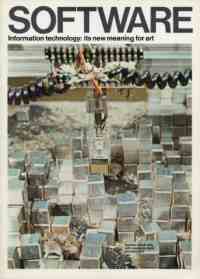
SOFTWARE, Jack Burnham, 1970

THE catalogue, for real :)
monoskop has uploaded a pdf of Jack Burnham's seminall SOFTWARE exhibition at the Jewish Museum in New York in 1970.

the few copies that are circulating in vintage book stores cost around 1.500 dollars at the moment.

thank you so much for digitizing and uploading, monoskop!!!


http://monoskop.org/images/3/31/Software_Information_Technology_Its_New_Meaning_for_Art_catalogue.pdf

Thursday, September 27, 2012

Saturday, September 22, 2012

Thursday, September 20, 2012

Mainframe Experientalism

http://www.ucpress.edu/book.php?isbn=9780520268388


Mainframe Experimentalism

Early Computing and the Foundations of the Digital Arts

Hannah B Higgins (Editor), Douglas Kahn (Editor)

Available worldwide
 
Mainframe Experimentalism challenges the conventional wisdom that the digital arts arose out of Silicon Valley’s technological revolutions in the 1970s. In fact, in the 1960s, a diverse array of artists, musicians, poets, writers, and filmmakers around the world were engaging with mainframe and mini-computers to create innovative new artworks that contradict the stereotypes of "computer art." Juxtaposing the original works alongside scholarly contributions by well-established and emerging scholars from several disciplines, Mainframe Experimentalism demonstrates that the radical and experimental aesthetics and political and cultural engagements of early digital art stand as precursors for the mobility among technological platforms, artistic forms, and social sites that has become commonplace today.

Tuesday, July 17, 2012

Ghosts in the Machine

Copying from e-flux..http://www.e-flux.com/announcements/ghosts-in-the-machine/
interesting list of artists http://www.newmuseum.org/exhibitions/466
installation shots http://www.nytimes.com/slideshow/2012/07/20/arts/design/20120720-GHOSTS.html

New Museum to Open Major Survey Exhibition Exploring the Relationship between Art and Machines on July 18
Ghosts in the Machine Will Present Fifty Years of Work by Artists, Writers, and other Visionaries Past and Present


Ghosts in the Machine surveys the constantly shifting relationship between humans, machines, and art. Occupying the Museum's three main galleries, the exhibition examines artists' embrace of and fascination with technology, as well as their prescient awareness of the ways in which technology can transform subjective experience. International in scope, Ghosts in the Machine spans more than fifty years and incorporates works by a range of historical figures and contemporary artists from fifteen countries. Together, the works on view will trace the complex journey from the mechanical to the optical to the virtual, looking at the ways in which humans have projected anthropomorphic behaviors onto machines and how those machines have become progressively more human. Eschewing a traditional chronological approach, Ghosts in the Machine has been conceived as an encyclopedic cabinet of wonders, bringing together an array of artworks and non-art objects to create an unsystematic archive of man's attempt to reconcile the organic and the mechanical.

Ghosts in the Machine will be on view from July 18 to September 30, 2012. The exhibition is curated by Massimiliano Gioni, Associate Director and Director of Exhibitions, and Gary Carrion-Murayari, Curator.

The installation at the New Museum will include over seventy artists, writers, and visionaries whose work has explored the fears and aspirations generated by the technology of their time. From Jakob Mohr's influencing machines to Emery Blagdon's healing constructions, Ghosts in the Machine brings together improvised technologies charged with magical powers. Historical works by Hans Haacke, Robert Breer, Otto Piene, and Gianni Colombo, among others, will be displayed alongside reconstructions of lost works and realizations of dystopian mechanical devices invented by figures like Franz Kafka and Raymond Roussel. Ghosts in the Machine also takes its cue from a number of exhibitions designed by artists that incorporated modern technology to reimagine the role of art in contemporary societies, including Richard Hamilton's influential Man, Machine and Motion (1955), which has never before been on view in New York. Exploring the integration of art and science, Ghosts in the Machine also tries to identify an art historical lineage of works preoccupied with the way we imagine and experience the future, delineating an archeology of visionary dreams that have never become a reality.

Many of the artists in the show take a scientific approach to investigating the realm of the invisible, dismantling the mechanics of vision in order to conceive new possibilities for seeing. Central to the exhibition is a re-examination of Op Art and perceptual abstraction, with a particular focus on the work of painters Bridget Riley, Victor Vasarely, Richard Anuszkiewicz, and Julian Stanczak, among others. Op Art was unique in the way it internalized technology and captured both the ecstatic and threatening qualities it posed to the human body. Furthermore, the exhibition will include a number of kinetic and "programmed" artworks as well as expanded cinema pieces, which amplify the radical effects of technology on vision. A section of the exhibition will present a selection of experimental films and videos realized with early computer technology. One highlight of the installation will be a reconstruction of Stan VanDerBeek's Movie-Drome (1963–66), an immersive cinematic environment where the viewer is bathed in a constant stream of moving images, anticipating the fusion of information and the body, typical of the digital era.

The works in Ghosts in the Machine are assembled across a variety of media to form a prehistory of the digital age. As technology has accelerated and proliferated dramatically over the past twenty years, artists have continued to monitor its impact. A number of contemporary artists, including Mark Leckey, Henrik Olesen, Seth Price, and Christopher Williams, will be represented in the exhibition. These recent works, while reflecting technological changes, also display a fascination with earlier machines and the types of knowledge and experiences that are lost as we move from one era to the next, constantly dreaming up new futures that will never arrive.


Catalogue
Ghosts in the Machine is accompanied by a fully illustrated catalogue featuring essays by Massimiliano Gioni, Associate Director and Director of Exhibitions, Gary Carrion-Murayari, Curator, and art historian Megan Heuer. The publication also includes an anthology of historical sources that have shaped the discourse around technology's impact on human perception and creativity. These primary documents complement the works in the show by situating them in relation to cultural phenomena like psychoanalysis, cybernetics, and media theory. The book makes hard-to-find articles on kinetic art and Op Art newly available, featuring texts by artists George Rickey, Victor Vasarely, Bridget Riley, Otto Piene, and GRAV, as well as curators Peter Selz, William Seitz, and Lawrence Alloway. Also included are a selection of texts on expanded cinema from Gene Youngblood, Stan VanDerBeek, and Paul Sharits, and an account of the art and technology movement by Calvin Tomkins.


Wednesday, May 9, 2012

http://jussiparikka.net/2012/05/08/what-is-media-archaeology-out-now/

Media Archaeology

Approaches, Applications, and Implications

Erkki Huhtamo (Editor), Jussi Parikka

Thursday, March 29, 2012

rot 19 - Georg Nees, Max Bense 1965

some wonderful person digitized and uploaded Max Bense and Georg Nees' seminal rot 19 publication from 1965 to compart big, big thank you!

Tuesday, January 3, 2012

The Information Machine (1958)

Charles and Ray Eames' 10' short “The Information Machine” was commissioned by IBM to introduce the computer at the 1958 Brussels’ World’s Fair.

More at the architizer blog

Monday, November 28, 2011

Historiographies of New Media: CFP

Call for Papers (Deadline November 28)
Historiographies of New Media

The Chicago Art Journal, the annual publication of the University of Chicago Department of Art History, is seeking submissions of original work by graduate students and faculty for its 2011-2012 edition. This year’s issue asks how new media have affected not only the production of art, but also the production of knowledge about art. What is at stake in approaching art history through the concept of new media?

The term ‘new media’ has been applied to a range of formats (from photography to video to the internet) that have revolutionized the modes of transmission and reproduction of ‘old’ media of art--particularly in the post WWII period. Although the concept of new media seems to promise a mass media address, artists have often emphasized the limits of circulation—for instance, in closed circuit television, or zines that made use of Xerox processes and yet were distributed to small networks through the mail. Such a dialectical relation escapes media theory’s emphasis on mass distribution, and points instead toward misalignments and points of friction between the imaginative and material aspects of new media. Furthermore, from the double slide lecture to the publication of photographs in books, and from the use of facsimiles in the classroom to broadcasts of ‘art on television,’ the formation and performance of the art historical discipline has itself been contingent upon pivotal introductions of reproductive media. In turning our attention to new media, we consider art history’s rhetorics of description and display. What conditions of possibility are embedded (or not) in the positioning of art as new media? How might we emphasize the aesthetic and pedagogical aspects of new media over notions that emerged out of communications theory, such as interactivity? We are especially interested in papers that address new media art histories that diverge from the well-known chronologies of Euro-American technological developments.

Topics might include but are not limited to:

-performance and circulation of art history through facsimiles, photographs,

slide projections, radio, and television

-responses and counter-responses to new media technologies within art criticism, critical theory, and film theory

-legacies of Friedrich Kittler and Miriam Hansen for theorizing new media

-analog and digital in art and art history

-historical modes of mechanical reproduction, imprinted coins, technologies of the book, seals, etc.

-transfers and transformations among media, media as reference for other media

- in what way are new media performative and public?

-materiality of new media, processes of materials

-new media and abstraction

-wider implications of artists’ practices in Xerox, zines, artists’ books, flip books, holograms, etc.

-relationship between art transmitted through media and art as media

-aesthetics of television

-new media’s relevance for reframing art historical cycles and geographies of innovation

-art and technology movements, including the role of dance and ‘new music’

-computerized models of art, computational ways of thinking

-collectivity and coalitions, notions of ‘social media’

-photography as new media

-historiographies of ‘video art,’ including the role of projection

-queer aesthetics and new media

-painting after the advent of network theory

Submissions:

* Full papers must follow The Chicago Manual of Style, and should not exceed 4000 words. Each submission should include an abstract of approximately

500 words. If you would like to submit an abstract without a full paper, please contact the editors in advance. Both Word documents and PDFs are welcome.

* All contributors should include their name, address, telephone number, and email address. Authors are responsible for securing image reproduction rights and any associated fees.

Please send submissions to the graduate student editors Solveig Nelson and Stephanie Su atUChicagoArtJournal@gmail.com by November 28, 2011.

Monday, November 14, 2011

Zebrastraat : Call for Entries - New Technological Art Award Foundation Liedts-Meesen 2012

Zebrastraat : Call for Entries - New Technological Art Award Foundation Liedts-Meesen 2012:


After update_1 in 2006, with as curator Jean-Marie Dallet, professor and researcher linked to ÉESI, responsible of the laboratory of the école d'art Figures de l'interactivité, Angoulême-Poitiers, France, followed by update_2 in collaboration with the ZKM, Zentrum für Kunst und Medientechnologie in Karlsruhe and with as curator Peter Weibel, Director of the ZKM, and finally update_3, in collaboration with the Centre Pompidou, Service Nouveaux Médias and as curator Christine Van Assche, guardian of the Centre Pompidou, we are determined to continue this series with update_4, to be held from 15th September till 18th of November 2012.

Read Full Article

review: »Klangmaschinen zwischen Experiment und Medientechnik«


Daniel Gethmann (Hrsg.): Klangmaschinen zwischen Experiment und Medientechnik. Bielefeld [Transcript Verlag] 2010

Wednesday, November 9, 2011

Backward Glances: A Media and Historiography Conference

Backward Glances


A Media and Historiography Conference
November 11 and 12, 2011
Northwestern University, Louis 119


Given the current emphasis on “new” media in diverse disciplines and fields, can we conceive of doing history as a "backward" practice? The aim of this interdisciplinary conference is twofold. While we explore the attachments and investments that scholars continue to have in historical objects and historiographic projects, we also want to consider media historiography as a deviant act. What are the political possibilities of media historiography's curious and precarious status? Does this approach to the past afford us a politics divorced from logics of reproduction, futurity, and progress?


Presented by The Center for Screen Cultures, Department of Radio/Television/Film, and The Alice Kaplan Institute for the Humanities, Northwestern University, Evanston, IL.


Organizers: Leigh Goldstein, Meenasarani Linde Murugan, and Maureen Ryan.


Special thanks to Lynn Spigel, Nick Davis, Jacqueline Stewart, Mimi White, Jeff Sconce, Andy Owens, Kate Newbold, Kimberly Nguyen, Dave Sagehorn, Chris Russell, and Molly Schneider.